Pepper and fish sauce, where they are made
Every island tour visits a pepper farm and a fish sauce house. Almost all of them visit the ones that pay the driver a percentage. This day goes to two working producers that pay us nothing and sell you nothing unless you ask.

At a glance
- Duration
- Eight hours, 08:00 - 16:00
- Group
- Maximum 8
- Starts
- Hotel pick-up, 07:40 - 08:10
- Ends
- Back at your hotel by 16:30
- Difficulty
- Easy, but uneven ground and full sun on the farm
- From
- USD 55 per person
Why the commission problem matters here more than anywhere
Pepper and fish sauce are the two products Phu Quoc is genuinely known for, and both have been comprehensively captured by the tour trade. The standard island day tour stops at a pepper farm and a fish sauce showroom where the driver receives between fifteen and thirty per cent of what the group spends. The farms know it, the drivers know it, and the prices are built to carry it.
The visible consequence is that you pay roughly double what a Vietnamese customer pays at a farm gate. The invisible consequence is worse: the route is chosen by who pays, so you are taken to the showroom with the parking rather than the farm with the pepper, and half of what you are told at the showroom is marketing.
We pay both producers a flat fee per group, agreed for the year, and take nothing from your purchases. If you buy pepper you pay the gate price, which in 2026 runs about 180,000 to 260,000 dong a kilo for black depending on grade. If you buy nothing the day is identical. The mechanism is explained in full on how we work with villages.
The farm
Two hectares at Khu Tuong, in the red laterite country in the middle of the island, run by one family with seasonal help at harvest. About 2,800 posts. Pepper is grown on living or dead wood posts here rather than on concrete, which is more expensive and produces a better vine, and the family will tell you why in more detail than you expect.
| What you see | What it tells you | Best months |
|---|---|---|
| The vines on their posts, three to four metres | How a pepper plant is trained and why it takes three years to produce | Any |
| Picking, if you are here in season | Why black, red and white pepper are the same berry at different stages | Feb - Apr |
| The drying yard | Why sun-dried pepper on concrete tastes different from machine-dried | Feb - May |
| Sorting and grading by hand | What separates a 500 g/l grade from a 550 g/l grade, and the price gap | Any |
| The 2024 price collapse, in the family accounts | Why perhaps a third of Phu Quoc pepper land has gone to other crops | Any |
The last row is the reason this stop is interesting rather than decorative. Phu Quoc pepper has a protected designation and a genuine reputation, and it is also a crop that has had a very hard decade. The family is direct about their numbers and about whether their children will farm.
The fish sauce house
A working nha thung on the Duong Dong outskirts with about forty wooden vats, each holding twelve to fifteen tonnes. The vats are made of boi loi wood, hooped with rattan rather than steel, and the oldest in this house has been in use since the nineteen-seventies.
The process is three ingredients and a year: anchovy caught in the waters south of the island, salt from Ba Ria at a ratio of about three to one, and time. Nothing is heated and nothing is added. The first drawing off the vat, the nuoc mam nhi, comes out at 38 to 43 degrees of nitrogen and is what the island exports under its protected name. What most of the world buys as Phu Quoc fish sauce is a later, diluted drawing, and the difference is explained standing next to the tap.
It smells. There is no polite way around this and anyone who tells you the smell is not strong has not been inside. Thirty seconds in, most people stop noticing. If you know you will not, say so and we will keep that stop to the yard.
Day by day
Khu Tuong pepper, a farm lunch, and the vats
Collected between 07:40 and 08:10 and inland on the Duong Dong to Ham Ninh road, then north on red dirt. Forty minutes, the last ten of it slow, and in the dry season the vehicle arrives orange.
Two hours and fifteen minutes on the farm, which sounds long and is not: an hour of it is walking the rows and the drying yard with the owner, and the rest is sitting under the trellis tasting black, red and white pepper from the same vine against peppercorns from the mainland, which is the moment most people understand what the protected designation is actually about.
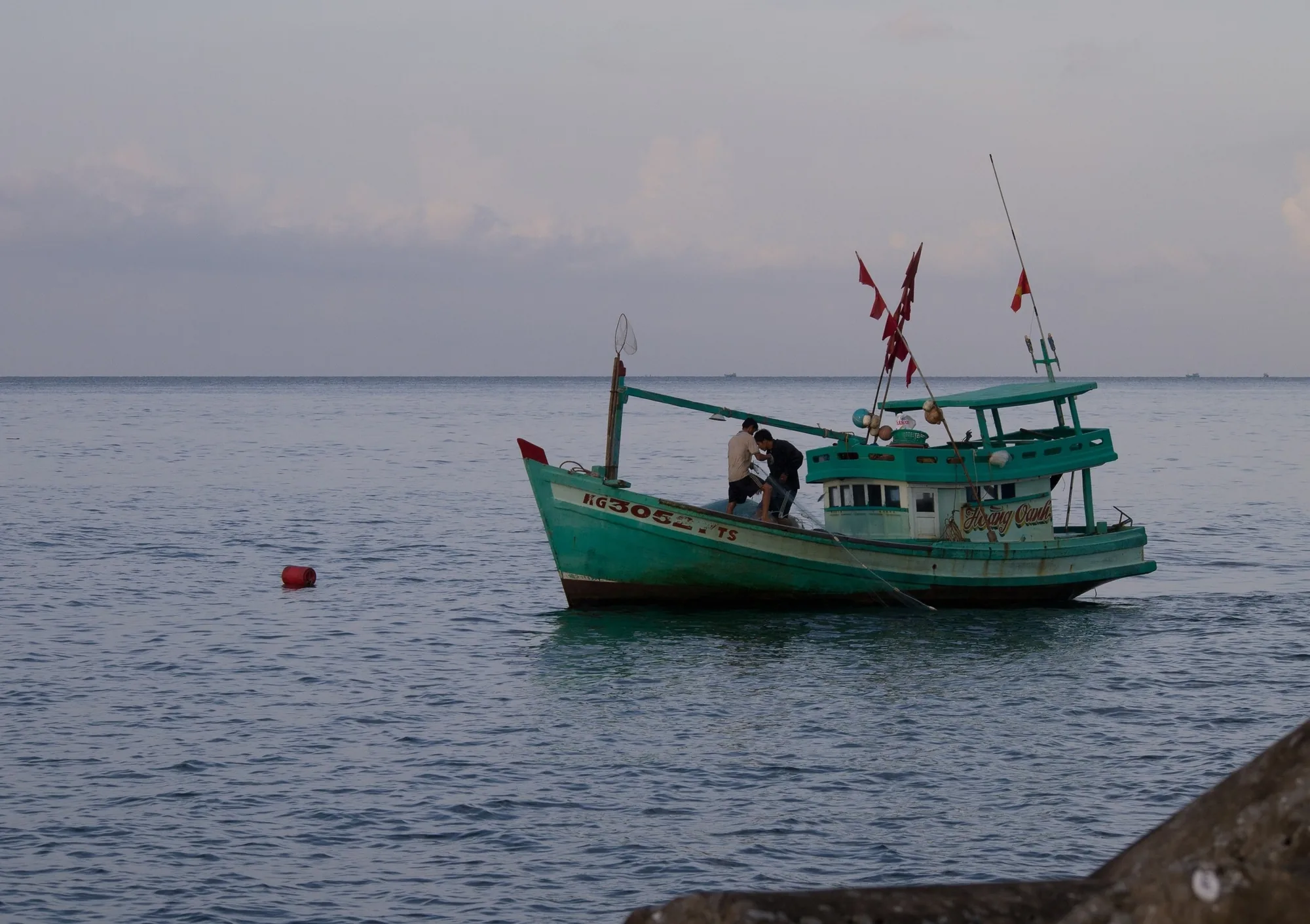
Lunch is cooked by the family in the garden at eleven: chicken with green pepper still on the stalk, rice, morning glory, a clear soup and fruit from the trees behind the house. In the afternoon we drive back towards Duong Dong for the fish sauce house, and finish on the Ham Ninh road where the anchovy boats and the salt come in, which is where the whole thing starts.

Prices
| Group size | Shared, per person | Private, whole group |
|---|---|---|
| 1 traveller | USD 96 | USD 96 |
| 2 travellers | USD 78 | USD 168 |
| 3 - 4 | USD 62 | USD 262 |
| 5 - 6 | USD 55 | USD 345 |
| 7 - 8 | USD 55 | USD 425 |
The optional cashew and sim wine smallholding adds about an hour on the way back and costs USD 9, which goes to the smallholder. It is worth doing if you are interested in the crop mix that has replaced pepper; it is not worth doing for the sim wine, which you can taste anywhere. The prices page shows what the day costs us to run.
What the price includes
- A guide for the whole day, in English, who interprets on the farm
- Hotel transfers within the standard zone in a vehicle sized to the group
- Two hours and fifteen minutes at the pepper farm with the owner
- Lunch cooked by the farm family in their garden
- An hour and a half at the fish sauce house, including the vat room
- All tastings: three pepper grades, two fish sauce drawings
- The flat visit fee we pay both producers, handed over in front of you
What it does not include
- Anything you buy - you pay the gate price and we take nothing
- The optional cashew smallholding, USD 9 per person
- Alcohol
- Travel insurance
- Tips
Gallery

Who this day is not for
- Anyone who cannot tolerate strong smells. The vat room is genuinely powerful and about one person in twenty finds it too much.
- People who wanted a shopping trip. There is no showroom, no gift packaging and no card machine at the farm - bring cash if you want to buy.
- Travellers who dislike heat. The farm has almost no shade between ten and midday and in April it reaches 35 C on the drying yard.
- Anyone in a hire car who wants to follow us. The last three kilometres are red dirt that turns to clay after rain and we will not lead a two-wheel-drive car up it.
- People who need a lot of variety in a day. This is two places, in depth. If you want six stops, this is the wrong day and we will say so.
Questions travellers ask most
Is there any point coming outside the harvest?
Yes, though it is a different day. February to April you see picking and the drying yard full, which is the photogenic version. Outside those months you see the vines, the sorting, the grading and the farm accounts, and you get considerably more of the owner attention because he is not working.
The fish sauce house is the reverse: the barrels are filled from July, so July to September is when the yard is busiest.
Can we buy pepper and fish sauce, and can we fly with it?
You can buy both at the gate price. Pepper travels without any problem. Fish sauce must go in checked baggage, sealed and bagged, and the producers sell it in the plastic bottles airlines accept rather than the glass ones that leak.
We take no commission on either, so the guide has no view on whether you buy.
Is the pepper farm the one on the standard island tour?
No. The farms on the standard circuit are near the main road with parking for coaches, and most of them run on commission. Ours is twenty-five minutes further in on dirt and has no parking to speak of.
It is a working farm, so occasionally the family is dealing with something urgent and the visit shifts by an hour. We tell you rather than substituting a showroom.
How much walking is there really?
About three kilometres across the day, in three separate stretches, none of them longer than about twenty-five minutes. The ground on the farm is uneven red earth with irrigation channels, so wear something closed.
There is a chair under the trellis at every point of the farm visit and nobody has to do the full walk.
Read next
Tell us what you want out of the island
Dates, party size and the places you care about are enough to start. You get a draft route and an indicative price, not a brochure.