The honest answer, including the parts against us
We sell days built around the word authentic, so we are the last people who should be trusted with this question. Here is our attempt at answering it anyway, with the case against us set out as clearly as we can put it.
The short answer
Parts of Phu Quoc have been comprehensively developed and parts of it have barely changed, and the two are twenty minutes apart. The west coast strip from Duong Dong to An Thoi is a resort coast and will not be anything else again. The north, the east coast and the middle of the island are still farms, forest and fishing hamlets.
The honest verdict: if you come expecting an undiscovered island you will be disappointed within an hour of landing. If you come expecting a developed island with a working one behind it, you will find exactly that, and the working one is genuinely good. Whether that is worth a flight is your judgment rather than ours.
What has actually been lost
Being specific is more useful than being gloomy. Here is what has gone, in rough order of how much it matters.
| What | When | How much it matters |
|---|---|---|
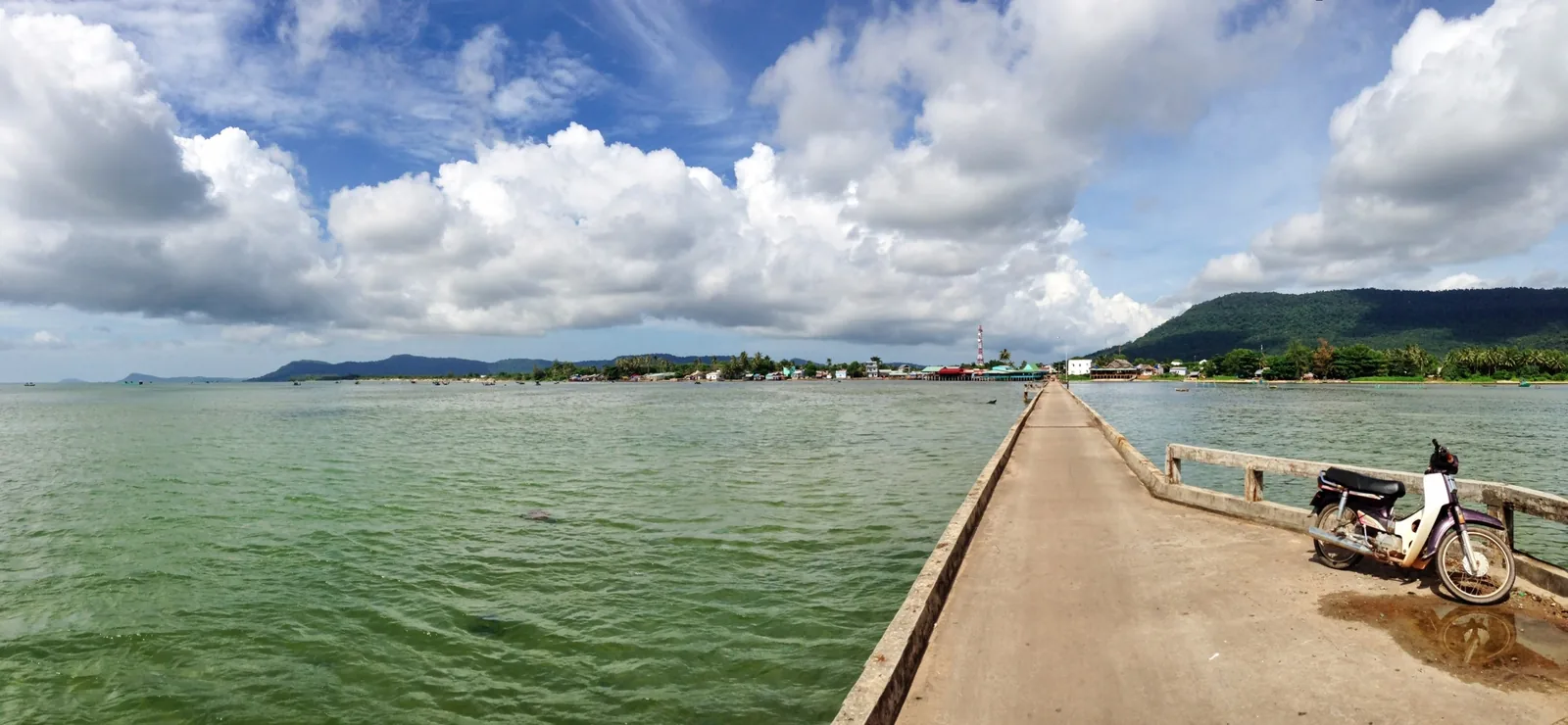
| The Ham Ninh stilt pier | Around 2020 | A great deal. The most photographed structure on the island, and it is gone |
| The empty west coast | 2015 - 2022 | A great deal, and irreversibly. Twenty kilometres of continuous hotel |
| Rach Vem as a quiet hamlet | 2019 onwards | Moderately. Still a hamlet on weekdays, a car park at weekends |
| Cheap accommodation near the beach | 2016 onwards | Moderately. The budget end moved inland |
| A large part of the pepper acreage | 2020 - 2025 | Significantly for the farmers, less visibly for visitors |
| Parts of the An Thoi urban fabric | 2025 - 2027 | A great deal locally. Whole blocks cleared for the APEC works |
The Ham Ninh pier is the one that comes up constantly, because the photograph of it is still used to sell tours to a village where it no longer stands. We wrote about that on the Ham Ninh page.
What the APEC construction is doing
Phu Quoc is delivering twenty-one government-assigned projects worth roughly 137 trillion dong - about 5.25 billion dollars - before the APEC economic leaders week in 2027. That includes the airport expansion across more than a thousand hectares with a 3,500 metre runway and a second runway, a convention centre on twenty-eight hectares with a 3,500-seat hall, new urban districts at Bai Dat Do and Nui Ong Quan, a boulevard, water reservoirs, waste treatment and more than thirteen thousand resettlement plots.
For a visitor in 2026 this means dust, diverted roads, heavy truck traffic on the west coast road, hoardings where houses were, and construction noise starting early. The worst of it is the corridor from the airport south to An Thoi. The north of the island is largely untouched so far.
For the island it means something larger and not entirely predictable. Thirteen thousand resettlement plots implies a substantial rearrangement of where people live. Some families who fished from a particular shore now live inland from it. We would be lying if we said we knew how much of the working island survives that, and anyone who tells you confidently either way is guessing.
A visitor who arrives expecting an unspoilt island and finds a construction site feels cheated, and reasonably so. A visitor who was told in advance sees the same island and finds the villages behind it more interesting, not less.
What is still here
- The dawn economy. Boats still land at Ham Ninh, Cua Can, Rach Vem and An Thoi between half past five and seven every morning, and the trade that follows is not staged for anybody.
- The north. From Cua Can up to Ganh Dau and across to Bai Thom is gardens, pepper, forest and red dirt, with no resorts of consequence and very little traffic.
- The food. Duong Dong has more genuinely local kitchens than it did ten years ago, not fewer, because the population has grown.
- The two crafts. Fish sauce is still made in wooden vats over a year, and pepper is still grown on wooden posts and dried on concrete in the sun.
- The wooden shipyards at An Thoi. Boats are still built by hand, and that is genuinely rare.
- Space. The island is 574 square kilometres with about 180,000 people and most of the development is on one twenty-kilometre strip.
The case against us
We benefit from you believing the answer is yes, so treat everything above with the scepticism that deserves. Here are the strongest arguments against what we sell, stated as well as we can state them.
- We are part of the problem. Every visitor we bring to Rach Vem or Ham Ninh makes those places slightly more visited. Small groups reduce that effect; they do not eliminate it. The only way to have zero impact is to not go.
- Authenticity is partly a performance once money is involved. The family we take you to has been paid to have you there. They would be cooking dinner anyway, but they would not be cooking it for you. That difference is real and we cannot argue it away.
- The word is marketing. We use it in our domain name. Every operator on this island claims it, including the ones running commission circuits, which is precisely why the word is now close to worthless as a signal.
- You could do most of this alone. Hire a scooter, go to Ham Ninh at six, buy a coffee and stand still. It costs almost nothing. What you pay us for is interpretation and access, not permission.
- Some of what we show you will be gone in five years. We do not know how much. Selling a thing while it disappears has an uncomfortable edge to it and we are aware of it.
Who should come, and who should go elsewhere
Come if you want a developed island with a working one behind it, you are willing to get up early, and you would rather understand one place than photograph five. Come especially if you were coming for a beach holiday anyway and want two days that are not the beach.
Go elsewhere if you want an island that tourism has not reached. That island exists in Vietnam - Con Dao, parts of the Cham islands, the smaller Kien Giang islands - and Phu Quoc is not it and has not been for a decade. We would rather tell you that than have you arrive and discover it.
Still want to come?
Twelve days built around the working half of the island and its forest, in groups of six to twelve.
Questions travellers ask most
Should we come now or wait until after 2027?
Come now if you want the villages, because we do not know what they look like after the resettlement programme finishes. Wait if the construction disruption would spoil the trip for you, because it is real and it is loud.
Our own view, for what it is worth from an interested party: the north of the island is at its best right now.
Is the island overcrowded?
On the west coast strip in high season, yes, in places. Long Beach on a December evening is busy. The An Thoi island boat trips are very busy.
Twenty minutes inland it is empty. The crowding on Phu Quoc is remarkably concentrated.
Are the villages just put on for tourists?
Ham Ninh has a visitor-facing strip of restaurants and dried seafood stalls that exists for tour groups, and a working shore that does not. Both are real; they operate at different hours.
Cua Can has essentially no visitor infrastructure at all. Rach Vem has some and it is growing.
Does responsible tourism actually help here?
It helps specific families in specific ways that we can point at: a visit fee, a homestay night, a kitchen paid for a morning. That is a modest and verifiable claim and it is the only one we will make.
It does not offset the flight, it does not stop the construction and it does not preserve a village. Anyone claiming otherwise is selling.
Read next
Tell us what you want out of the island
Dates, party size and the places you care about are enough to start. You get a draft route and an indicative price, not a brochure.